

LAB Cryogenic Label Materials
Cryogenic is the most demanding line in the BRD material system: four temperature bands, three facestock families. This page documents material codes (T629, T429, T459 and so on); finished blank labels use separate LAB numbers.
The adhesive layer that holds in liquid nitrogen
Cryogenic labels usually fail not because the facestock tears, but because the adhesive loses its initial tack when the temperature changes abruptly: the label enters liquid nitrogen after application, the edges lift as it warms, and the barcode distorts with them.
The LAB series starts with the adhesive: the balance between initial tack and shear holding is adjusted for different container surfaces — polypropylene, polystyrene, glass and aluminium foil — and facestock and coating are then matched so that thermal transfer print stays legible after immersion at -196 °C and repeated freeze-thaw cycles.
Every series has a TDS datasheet, and shipments can include SGS composition and migration test reports together with ROHS 2.0 and HF test data.
- Temperature range-196 °C to -20 °CFour temperature zones; select by storage conditions
- Facestock systemsNylon cloth / polyester / synthetic paper / self-laminatingMatched to different containers and curves
- AdhesiveLow-temperature permanent acrylicOptimized for plastic and glass surfaces
- Printing methodThermal transfer (resin ribbon)Suited to resin ribbons
- DocumentsTDS / MSDS / SGS / COCAvailable per batch
- NumberingMaterial codes, T seriesBlank labels use TH / LAB numbers
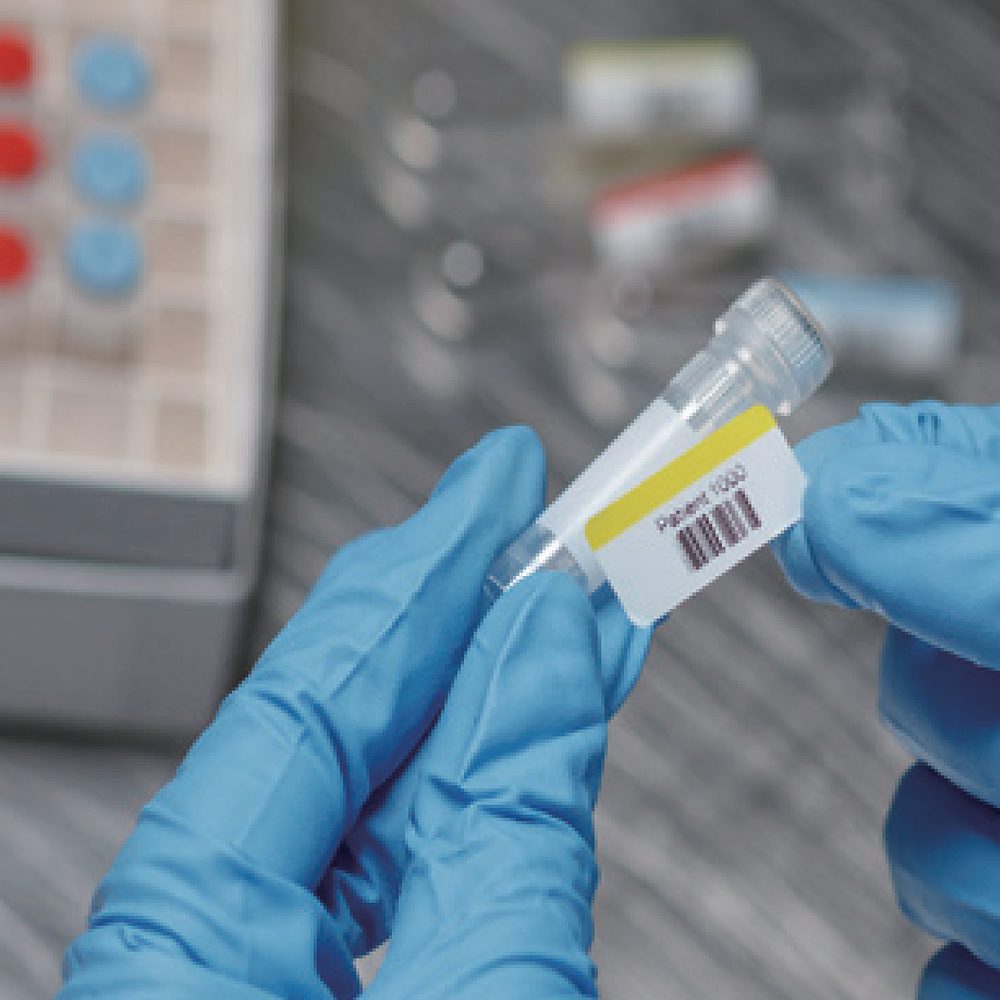
Four temperature zones, four approaches
-196 °C liquid nitrogen
Nylon cloth facestock with permanent acrylic adhesive, immersible in liquid nitrogen; for cryovials, microcentrifuge tubes and microscope slides.
-80 °C freezer
Polyester film facestock for long-term ultra-low freezer storage; coloured borders enable colour coding by project or batch.
Self-laminating structure
A laminate over the print area protects it against alcohol and disinfectant wipes; suited to microplates and conical tubes handled repeatedly.
Documented parameters
Every material code has a TDS listing peel adhesion, temperature range and recommended ribbon, so selection is not guesswork.
LAB material code comparison
One temperature band may offer several facestocks, differing in conformability, solvent resistance and cost. The table lists applications by material code.
| Material code | Temperature | Facestock / structure | Typical applications | Recommended ribbon |
|---|---|---|---|---|
| T629 | -196 °C | Nylon cloth + permanent acrylic adhesive | Cryovials, microcentrifuge tubes, microscope slides, foil bags | BRL series |
| T459 | -196 °C | Polyester + gloss self-laminating | Cryovials, conical tubes, microplates | BRL series |
| T509 | -80 °C | Polyester + matte self-laminating | Microplates, centrifuge tubes, reagent bottles | BRL series |
| T419 | -80 °C | Polyester film | Ultra-low freezer samples, strain tubes | BRL / BR400 |
| T429 | -80 °C | Polyester film (coloured optional) | Cryovials, centrifuge tubes, test tubes | BRL / BR400 |
| T439 | -80 °C | Coloured polyester + border printing | Colour-coded sample management, project separation | BRL / BR400 |
| T319 | -40 °C | Polyester laminate | Refrigerated samples, reagents | BR400 / BR100 |
| T329 | -40 °C | Polyester / synthetic paper | Reagent bottles, buffers, consumables | BR400 / BR100 |
| T449 | -40 °C | Polyester film | Low-temperature freezers, transfer boxes | BR400 / BR100 |
| TRF | -196 °C to -80 °C | RFID inlay + cryogenic facestock | Batch inventory, storage-location management | BRL series |
Temperature refers to the ambient range in which the material can be stored long-term; actual selection also depends on container material, surface radius and labelling method.
Four steps to a material in use
01 Requirements
Container type, dimensions, storage temperature, print method and existing coding rules.
02 Material selection
Recommend one or two material codes for the temperature band and container surface, with TDS data.
03 Sample validation
Free samples and a small trial run, tested against freeze-thaw and wiping following your real workflow.
04 Volume delivery
Production after specification confirmation, batch-by-batch COC, pre-printing and print service available.
Frequently asked questions
How do I choose between T629 and T429?
Start with storage temperature: for liquid nitrogen or long-term -196 °C storage choose T629 nylon cloth; for -80 °C ultra-low freezers the T419/T429 polyester materials are cheaper with sufficient print clarity. Both are material codes; when ordering blank labels they map to LAB numbers.
Can labels be custom-sized and printed?
Yes. We offer die-cutting to container dimensions, colour coding, pre-printed barcodes and text, and a print service. Small batches are accepted; the exact minimum order quantity depends on size and process.
Which printer and ribbon does it suit?
LAB materials are mainly thermal transfer; we recommend BRL series resin ribbons, commonly used with BRADY i5100/i7100/i7500 and CAB machines. Equipment and ribbons come from your production line or supplier; we supply material parameters and support sample testing.
Which compliance documents are available?
Shipments can include the TDS datasheet, the MSDS safety data sheet, SGS composition and migration test reports, ROHS 2.0 and HF test data, and a batch-by-batch COC.
How do I request samples?
Leave the container type, temperature and equipment details on the contact page, or call 18015583218. Samples are usually arranged the same day and reach Jiangsu, Zhejiang and Shanghai the next day.
Not sure which material to use?
Tell us the substrate, service temperature, print method and service life, and a materials engineer will propose a combination, with free samples and print validation.